 Primvaria
Usage in depth
Scene size and mixing, the preset list, moisture states, deformable grains, opening a scene in Blender.
Scene size and mixing
| Option (CLI / Python) | Default | Effect |
|---|---|---|
--shapes N / shapes=N |
100 | number of distinct grain shapes |
--copies K / copies=K |
5 | how many times each shape is placed; the scene has N × K grains |
--no-shuffle / shuffle=False |
shuffled | place the copies of each shape side by side, shape after shape, instead of mixing them, e.g. to compare shapes |
--seed S / seed=S |
1 | random seed; the same options and seed give the same scene |
--shapes and --copies must be at least 1. Turning shuffling off changes
only which shape goes in which slot: shapes, positions and orientations stay
the same.
Presets
| Category | Presets |
|---|---|
| Sand | beach_sand, dune_sand, volcanic_sand |
| Gravel | rounded_gravel, crushed_gravel, marble_chips, pozzolana |
| Pebbles | river_pebbles (rounded, equant, earthy mixed minerals), beach_pebbles (flat discs and ovals, polished basalt and marble) |
| Industrial | railway_ballast, iron_ore, coal, rubber_mulch (shredded recycled tyres: torn, grippy, bouncy nuggets) |
| Agricultural | wheat (kernels with a ventral crease), maize (wedge-shaped dent kernels), rice (long grain, milled), beans (kidney-shaped, mixed varieties), soybean, cherry_tomatoes (glossy skin, stem scar): deformable, NVIDIA OmniPhysics only (rigid elsewhere with --no-deformable), no moisture (waxy skin) |
| Pellets | plastic_pellets (PE/PP, ~3.4 mm), wood_pellets (6 mm diameter, 10–30 mm long, broken ends) |
| Packaging | packing_peanuts (expanded polystyrene, S or C shaped): deformable, NVIDIA OmniPhysics only (rigid elsewhere with --no-deformable), and no moisture: EPS never gets wet, water runs off |
| Space | lunar_regolith, martian_regolith (no moisture) |
| Reference | glass_beads: exact spheres, the baseline to compare real grains against |
Values are realistic orders of magnitude, not measurements of a specific deposit.
Moisture (OpenUSD variant set)
Every prototype carries a moisture variant set (dry, damp, wet,
saturated) and every grain selects its own. A state changes:
- mass: a wetter grain is heavier. Each state stores its own mass
(dry mass + water) in
physics:mass, plus the water alone ingranulaire:waterMass; switching the variant switches the mass; - appearance: darker colour, lower roughness, clearcoat (UsdPreviewSurface);
- contact: friction and restitution (one UsdPhysics material per state),
plus capillary cohesion in the custom attribute
granulaire:capillaryCohesion, since UsdPhysics has no standard schema for it.
The water comes from two sources: a surface film, which weighs a lot on small grains (much surface for little mass) and little on pebbles, capped by the water the pores of a heap can hold; and absorbed water, which dominates for porous stone (pozzolana) and for anything that soaks (seeds, beans, wood). Median weight gain of one grain, % of its dry mass:
| Material | Damp | Wet | Saturated |
|---|---|---|---|
| Beach sand | +3.6 % | +14 % | +24 % |
| Pozzolana (porous) | +6.2 % | +17 % | +22 % |
| Crushed gravel | +0.5 % | +1.5 % | +2.2 % |
| River pebbles | +0.2 % | +0.6 % | +0.8 % |
| Beach pebbles (dense basalt, marble) | +0.1 % | +0.3 % | +0.5 % |
| Plastic pellets | +1.0 % | +4.0 % | +7.0 % |
| Wheat | +9.6 % | +26 % | +34 % |
| Soybeans | +12 % | +34 % | +43 % |
| Wood pellets | +15 % | +41 % | +52 % |
| Common beans | +27 % | +73 % | +92 % |
Every preset's values are in manifest.json (median_water_content_pct, in
its summary) and per grain in instances.csv (measured:mass_<state>_kg).
- No swelling. A wet grain gets heavier but keeps its shape and size. In reality beans, seeds and wood pellets swell when soaked, so their wet density is overstated.
- Indicative values. Water contents, contact and cohesion coefficients are model orders of magnitude, not measurements, and still need calibrating.
In usdview or Omniverse, change a grain's state by changing its variant selection. Blender's USD importer takes the state selected at import time.
Presets with no moisture states, even with --moisture: the regoliths (no
liquid water), the polystyrene packing peanuts (EPS never gets wet: water
runs off) and the cherry tomatoes (water beads on the waxy skin).
Deformable grains (packing peanuts, cherry tomatoes)
Works only with NVIDIA OmniPhysics, and not tested yet. Deformable simulation of
packing_peanutsandcherry_tomatoesrequires an engine that reads NVIDIA's OmniPhysics deformable schema: Omniverse Kit and Isaac Sim 5 or later, where PhysX runs it on the GPU. Everything else (Blender, usdview, MuJoCo, Bullet, engines reading only standard UsdPhysics) reads the file itself, where these grains are ordinary rigid bodies.Granulaire is developed without an NVIDIA GPU: the files are checked to be valid OpenUSD with the documented schemas and attributes, but they have never been simulated in Isaac Sim. In some releases the schema is a beta feature that must be enabled. Feedback from anyone who runs them is very welcome.
Why: core OpenUSD has no deformable-body schema yet. UsdPhysics covers rigid
bodies only (UsdPhysics overview);
the AOUSD Physics Working Group lists deformable and soft bodies only as a
possible future extension
(charter).
The file granulaire_<preset>.usdc therefore holds plain OpenUSD and
UsdPhysics only, with these grains as rigid bodies. What makes them
deformable follows NVIDIA's OmniPhysics deformable schema
(reference),
built on the core UsdGeom.TetMesh, and is written as a layer over the file,
granulaire_<preset>_omniphysics.usdc. Open the layer instead of the file
(Isaac Sim: File > Open) and each grain becomes:
/World/Prototypes/Grain_000   Xform  + OmniPhysicsDeformableBodyAPI (omniphysics:mass)
                                     - PhysicsRigidBodyAPI, PhysicsMassAPI (removed by the layer)
  geom                        Mesh   + OmniPhysicsDeformablePoseAPI:custom (bind pose)
  collision                   the rigid collider, deactivated by the layer
  sim                         TetMesh + OmniPhysicsVolumeDeformableSimAPI
                                      + OmniPhysicsDeformablePoseAPI:custom
                                      + PhysicsCollisionAPI
/World/Looks/Soft             Material + OmniPhysicsBaseMaterialAPI (density, friction)
                                       + OmniPhysicsDeformableMaterialAPI
                                         (Young's modulus, Poisson's ratio)
                                       + PhysxDeformableMaterialAPI
                                         (elasticity damping)
The layer has the file as its only sublayer. python -m granulaire.omniphysics
<folder> checks its structure (every grain deformable and no longer rigid,
simulation mesh and rest shape, mass equal to the file's, deformable
material); the OpenUSD validators run on it in CI.
- The simulation mesh fills the grain's volume with tetrahedra (voxels split into 6 tetrahedra each, ~1,300–1,400 per grain); the render mesh follows it through the bind pose. The tetrahedral volume matches the surface within a few percent.
- The schemas are applied by name, so the layer stays valid OpenUSD in any
tool, but only OmniPhysics acts on them.
usd-coredoes not list unregistered schemas inGetAppliedSchemas(), but they are in the file (apiSchemasmetadata). - NVIDIA's schema is still evolving (it replaced an earlier PhysX deformable API); if a newer Omniverse release renames attributes, re-export with an updated Granulaire. If OpenUSD standardises deformables, the export will move to that schema.
--no-deformabledoes not write the layer (and skips the tetrahedral meshes).- Bounce. Deformable materials have no restitution: a grain bounces
through its own elasticity, and
physxDeformableMaterial:elasticityDamping(1/s) sets how much energy each deformation loses. The values below are uncalibrated starting points, to tune in Isaac Sim. - Material values are indicative:
| Preset | Young's modulus E | Poisson's ratio ν | Elasticity damping |
|---|---|---|---|
packing_peanuts (EPS foam) |
≈ 1 MPa | ≈ 0.1 | 0.02 /s |
cherry_tomatoes (soft fruit, keeps its volume when squeezed) |
≈ 0.5 MPa | ≈ 0.45 | 0.01 /s |
In Blender
The .usdc scene opens directly in Blender (File > Import > USD).
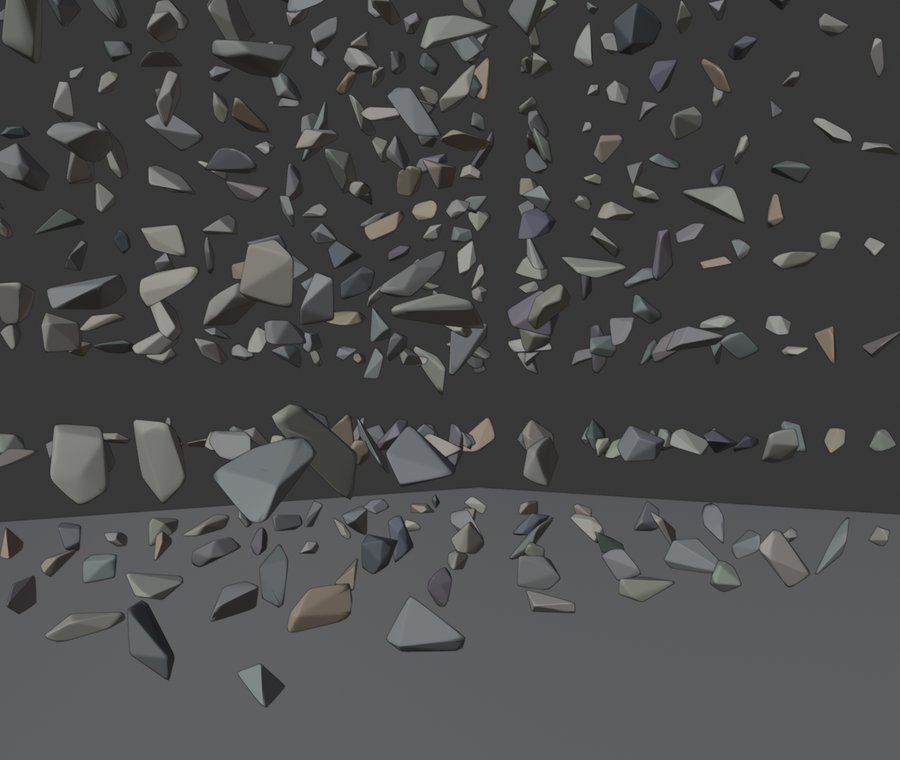 |
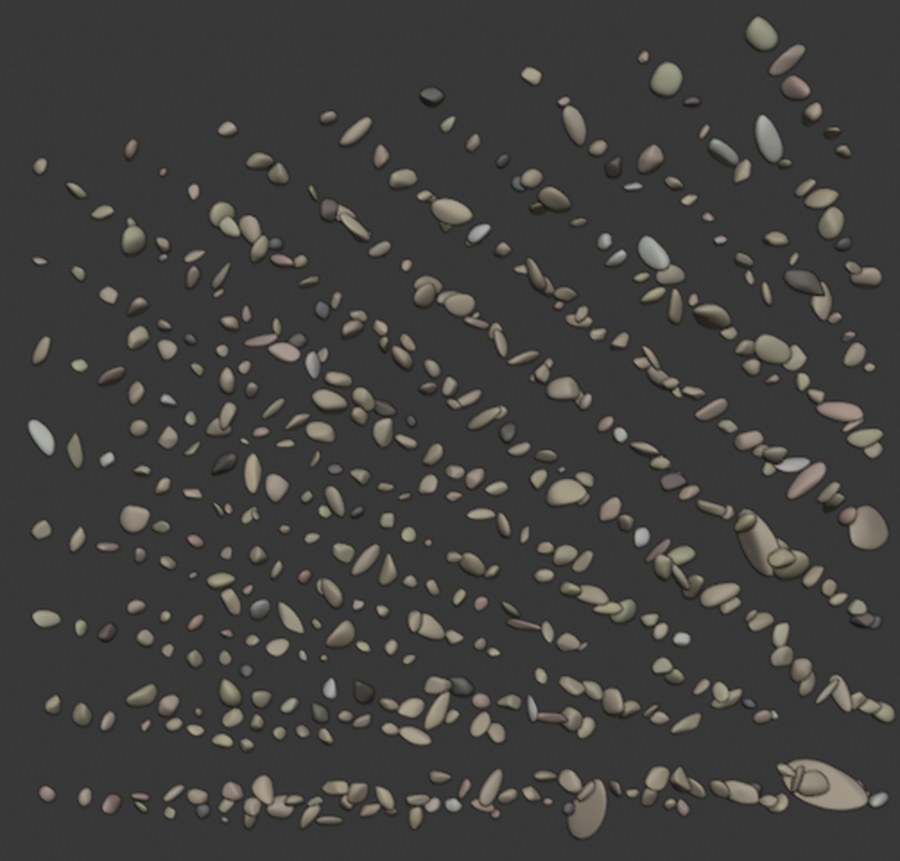 |
| Crushed gravel falling onto the floor (Blender rigid-body physics) | Beach sand, rounded grains in mineral colours |
Screenshots from the first version (0.1.0); grain shapes have become more varied since then.