 Primvaria
The engine-neutral stiffness, the MuJoCo and OmniPhysics exports, and the drape tests in Blender and MuJoCo with their results.
Blender drape test
maillage drop-test imports the scene into Blender and, for each tested
piece:
- sets up Blender's cloth solver from the
maillage:*attributes: stiffness rescaled to the mesh and the piece's real mass, stiffer bending on the hem, collisions and self-collisions; - drape: lays the piece flat on a round pedestal (diameter 60 % of the shorter side), its centre clamped as between the two discs of a Cusick drape tester, and lets the rest fall; hang: a flag hangs from its two hoist corners on a pole, optionally in the wind;
- simulates 5 s (120 frames at 24 fps);
- checks the result and writes
drop_test.json:
| Check | Pass when |
|---|---|
| finite | no invalid coordinate |
| stretch | 99 % of the edges stretched by less than 10 %, none by more than 60 % |
| penetration | less than 0.5 % of the vertices inside the pedestal or under the floor |
| at rest | (drape) fastest vertex below 10 cm/s at the end |
It also measures the drape coefficient of each draped piece, as in the
Cusick test: (projected area − pedestal area) / (flat area − pedestal area),
from 1 (stays flat) to 0 (hangs straight down). The draped meshes are exported
to draped.usdc with their maillage:* attributes copied back: ready-to-use
draped assets.
Results
Indicative results of maillage drop-test on three pieces of each preset
(seed 1, ~1,500 vertices per piece, 120 frames, Blender 5.2):
| Preset | Mass (g) | Vertices | Scenario | Drape coefficient | Stretch (p99) | Result |
|---|---|---|---|---|---|---|
bath_towel |
429–450 | 1563–1582 | drape | 0.22–0.23 | 3.1–3.7 % | 3/3 pass |
hand_towel |
219–229 | 1563–1585 | drape | 0.22–0.26 | 2.6–3.6 % | 3/3 pass |
washcloth |
39–41 | 1562–1572 | drape | 0.40–0.49 | 4.2–5.1 % | 3/3 pass |
tea_towel |
75–78 | 1549–1570 | drape | 0.28 | 2.8–2.9 % | 3/3 pass |
napkin |
28–29 | 1559–1578 | drape | 0.36–0.38 | 2.2–2.6 % | 3/3 pass |
tablecloth |
356–470 | 1564–1572 | drape | 0.20–0.25 | 3.1–4.0 % | 3/3 pass |
bed_sheet |
636–863 | 1553–1573 | drape | 0.28–0.37 | 3.0–3.1 % | 3/3 pass |
microfiber_cloth |
47–49 | 1554–1575 | drape | 0.37–0.41 | 2.2–2.4 % | 3/3 pass |
bandana |
42–43 | 1558–1576 | drape | 0.30–0.33 | 2.5–3.1 % | 3/3 pass |
silk_scarf |
48–49 | 1560–1579 | drape | 0.25–0.27 | 3.1–3.4 % | 3/3 pass |
scarf |
134–189 | 1608–1621 | drape | 0.10–0.13 | 2.6–2.8 % | 3/3 pass |
flag |
170–174 | 1551–1567 | hang | — | 1.9–2.4 % | 3/3 pass |
No piece went through the pedestal or the floor. The drape coefficient
depends on the shape of the piece as much as on the fabric (a long towel
hangs further past a pedestal sized on its short side), so it compares
pieces of one preset, not presets with each other. To compare fabrics, the
same 40 cm square was draped in each (maillage generate --preset napkin
--no-size --no-cut --fabric silk,polyester_knit,cotton_plain,linen,cotton_terry,denim):
| Fabric | silk | polyester knit | plain cotton | linen | cotton terry | denim |
|---|---|---|---|---|---|---|
| Mass of the square | 10 g | 18 g | 22 g | 29 g | 72 g | 64 g |
| Drape coefficient | 0.37 | 0.35 | 0.42 | 0.40 | 0.38 | 0.42 |
In Blender the fabrics differ in mass, thickness, friction and look much more than in drape: the drape coefficients stay within 0.35–0.42, where real silk and denim are far apart (see the roadmap). In MuJoCo, with the engine-neutral stiffness, they do not drape alike: see the fabric drape test.
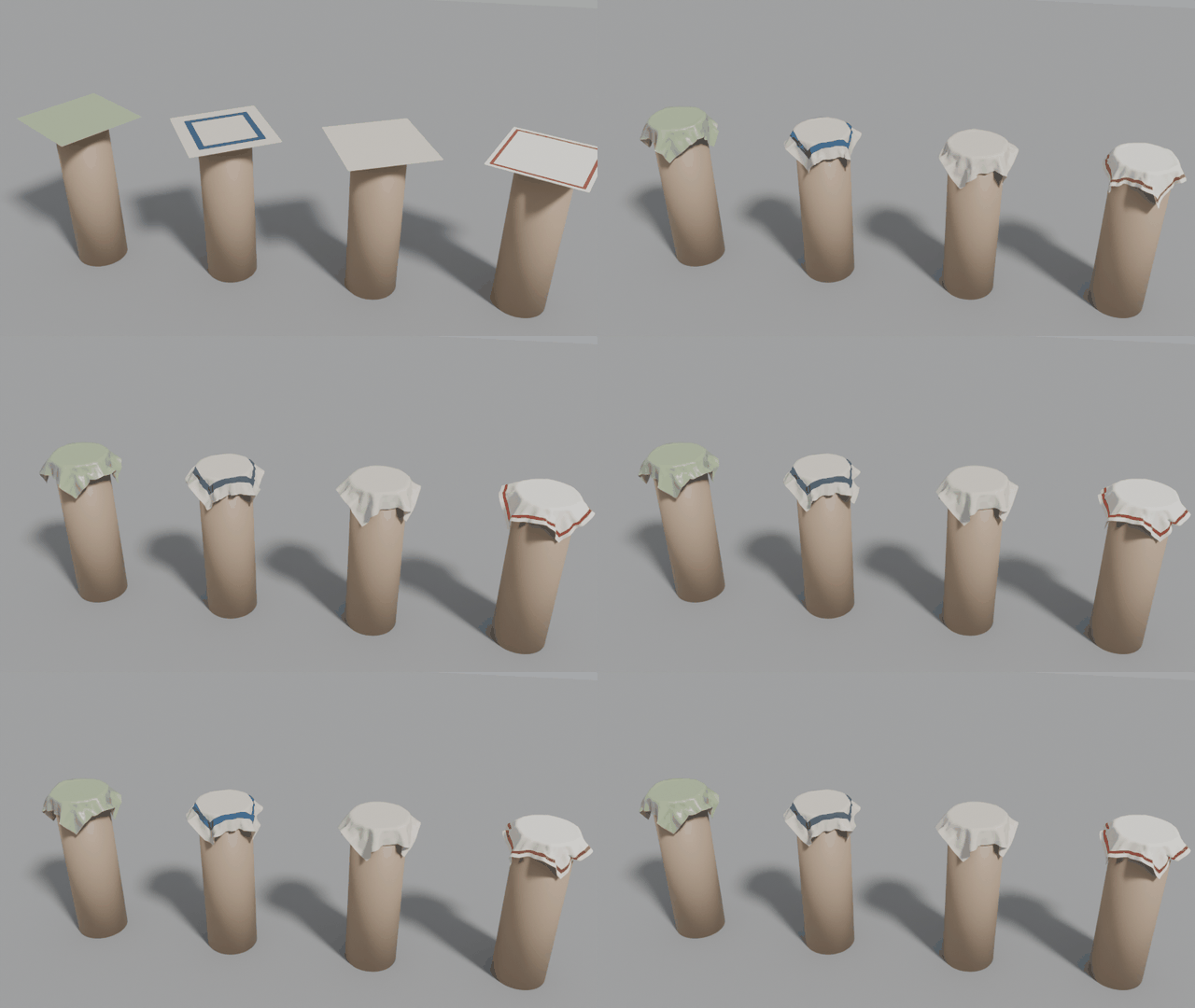
Silk, plain cotton, linen and denim squares falling onto the clamped
pedestals, slowed down twice: maillage generate --preset napkin --count 4 --fabric
silk,cotton_plain,linen,denim then maillage drop-test output/napkin --frames 40
--gif --gif-step 1.
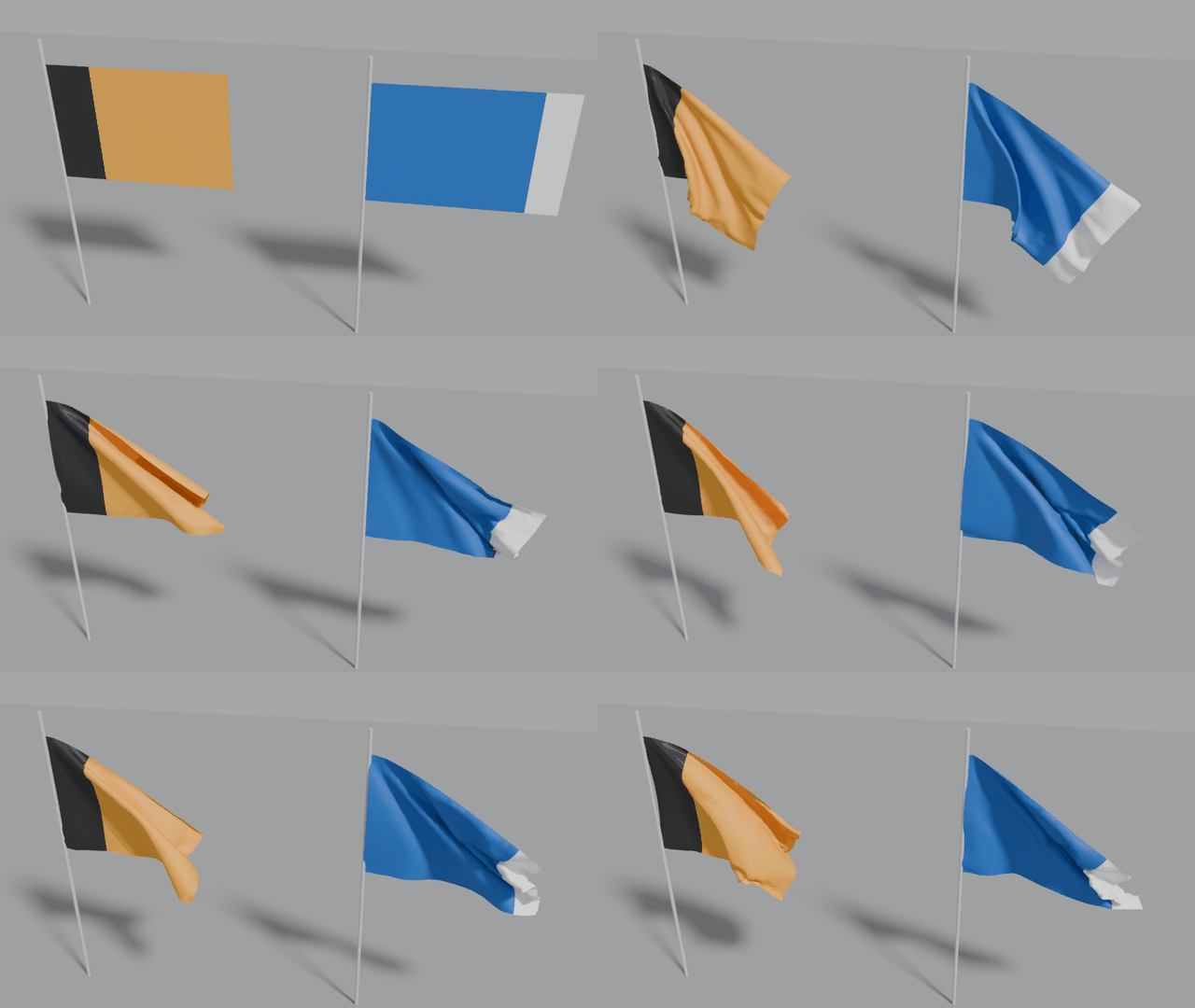
Flags hung by their hoist corners in the wind: maillage drop-test
output/flag --wind 4 --gif.
Blender values
Blender's cloth stiffness acts per edge and is not divided by the vertex mass, so the same numbers make a fabric stiffer or softer depending on the mesh resolution. Maillage stores the stiffness for a reference mesh with 1 cm edges and the real mass, and the drape test rescales it: tension and shear with the edge length, bending unchanged, air damping with the area per vertex. The solver itself runs with Blender's usual 0.3 kg vertex mass and every stiffness and damping multiplied by the same factor, which leaves the motion unchanged and keeps Blender's solver in the range its tolerances are tuned for.
Tension gives about 3 % stretch when a piece drapes; bending is smaller for softer fabrics, and kept low for all of them (see the roadmap). The values are not calibrated against measured fabric properties.
Engines
Every file is OpenUSD with standard UsdPhysics schemas. Where each engine
stands, as on the Primvaria engine matrix:
| Engine | Status |
|---|---|
OpenUSD validators (usdchecker) |
tested: every preset, OmniPhysics layer included, in CI |
| Blender | tested: drape test of every preset (maillage drop-test) |
| MuJoCo | tested: flex export and drape test of every preset (maillage sim-test); the fabrics drape differently (maillage fabric-test) |
| NVIDIA OmniPhysics (Isaac Sim 5+) | surface deformables exported, structure checked, not simulated yet |
The main file is engine-neutral; engine-specific exports are read back from it, so every engine sees the same piece.
Engine-neutral stiffness. Each fabric has a tensile (membrane) stiffness K in N/m, a bending rigidity B in N·m and a Poisson's ratio: orders of magnitude from published ranges (B from 1e-6 N·m for silk to 1e-4 N·m for denim; K from 1e2 N/m for a knitted scarf to a few 1e3 N/m for wovens), not measurements. Shell models (MuJoCo, OmniPhysics) take a Young's modulus E and a thickness t; the pair with E·t = K and E·t³ / 12(1 − ν²) = B gives both exactly. That t is a bending thickness, not the fabric's real thickness: fabrics bend far more easily than a solid plate of the same thickness.
| Engine | Export | Tested |
|---|---|---|
| Blender | the main file, through Blender's USD importer, with the maillage:blender:* stiffness |
yes: maillage drop-test, every preset in CI |
| MuJoCo | maillage_<preset>.xml: one flex per piece (flexcomp, triangle shell, elastic2d="both"), mass, friction |
yes: maillage sim-test, every preset in CI |
| NVIDIA OmniPhysics (Isaac Sim 5+) | maillage_<preset>_omniphysics.usda: surface deformables (OmniPhysicsDeformableBodyAPI, OmniPhysicsSurfaceDeformableSimAPI, OmniPhysicsSurfaceDeformableMaterialAPI), faces split into triangles |
structure only (python -m maillage.omniphysics, OpenUSD validators): not simulated, OmniPhysics needs an NVIDIA RTX GPU |
MuJoCo drape test
pip install "maillage[sim]"
maillage sim-test output/tea_towel --pieces 4
The same scenario and checks as the Blender drape test, built from the OpenUSD file only: drape on a clamped pedestal (or hang from the pinned vertices), 5 s, then finite values, stretch, penetration, at rest; plus mass (the flex's mass is the file's) and solver (no MuJoCo warning). The drape coefficient is measured.
MuJoCo settings, found with the test (MuJoCo 3.17; CI runs it on MuJoCo 4): the discrete integrator
(the only one that integrates flex elasticity implicitly), a 0.5 ms time step
(smaller when the membrane is stiff for the vertex mass, as for a small linen
napkin), the CG solver with a tight tolerance. MuJoCo cannot put air drag on
flex vertices in the XML: the test applies it as a force, 1 N·s/m³ per unit
of cloth area, the order of real air drag at draping speeds. Not modelled in
MuJoCo: self-collision, the stiffer hem (one stiffness per flex), wind.
Fabric drape test
maillage fabric-test                                  # every fabric, about 4 minutes on one CPU
maillage fabric-test --fabric silk,cotton_plain,denim
Do the fabrics drape differently, as real ones do? This drapes the same sample of each fabric in MuJoCo, a 30 cm disc on an 18 cm pedestal as in a Cusick drape tester, each in its own simulation, and measures its drape coefficient (1: the disc stays flat; 0: it hangs straight down). MuJoCo 4.0.1, 300 vertices, 4 s:
| Fabric | Bending length | Tensile stiffness | Drape coefficient |
|---|---|---|---|
polyester_knit |
1.10 cm | 600 N/m | 0.51 |
silk |
1.19 cm | 300 N/m | 0.54 |
microfiber |
1.72 cm | 500 N/m | 0.57 |
wool_knit |
2.06 cm | 150 N/m | 0.61 |
fleece |
2.01 cm | 200 N/m | 0.62 |
cotton_waffle |
1.91 cm | 800 N/m | 0.63 |
cotton_terry |
2.08 cm | 600 N/m | 0.64 |
cotton_plain |
1.63 cm | 1500 N/m | 0.67 |
cotton_percale |
1.50 cm | 1500 N/m | 0.67 |
linen |
2.04 cm | 2500 N/m | 0.74 |
denim |
3.13 cm | 4000 N/m | 0.83 |
The bending length is Pierce's, (bending rigidity / weight per unit area)^(1/3): the length over which a fabric bends under its own weight. The drape coefficient rises with it, and with the tensile stiffness: to drape in folds a disc must also shear in its plane, which knits (low tensile stiffness) do more easily than wovens. That is the dependence Cusick found on real fabrics, on bending length and shear stiffness (Cusick, 1965).
The test passes when every sample passes the checks of the drape test, silk, plain cotton and denim drape in that order at least 0.05 apart, and the fabrics spread over at least 0.2 (here 0.32). CI runs it on every fabric.
What it does not show: the values are not calibrated, so a fabric's coefficient is not the one a Cusick tester would measure on it, and MuJoCo has no self-collision here, so folds can pass through each other. The mesh matters within about ±0.04: silk gives 0.52 to 0.59 and denim 0.83 to 0.89 between 300 and 1200 vertices, which leaves the order and the spread unchanged.
OmniPhysics layer
Open maillage_<preset>_omniphysics.usda in Omniverse or Isaac Sim: it
sublayers the main file and adds a physics scene, the deformable-body and
surface-simulation schemas on each cloth mesh (the mesh is both the body root
and its simulation mesh), rest shape and triangles, and one physics material
per fabric (Young's modulus, surface thickness, Poisson's ratio, density,
friction). Not exported yet: the pinned vertices of a flag (they need an
attachment) and the stiffer hem.