 Primvaria
The preset list, fabrics, formats, mesh options and how a piece is built.
Presets
| Category | Preset | Formats (cm) | Fabrics |
|---|---|---|---|
| Bath | bath_towel |
70×140, 90×150 | cotton terry |
hand_towel |
50×100, 40×60 | cotton terry | |
washcloth |
30×30 | cotton terry | |
| Kitchen | tea_towel |
50×70, 45×65 | waffle cotton, linen, plain cotton |
| Table | napkin |
40×40, 50×50 | linen, plain cotton |
tablecloth |
140×180, 140×240, round ⌀150, oval 140×200 | plain cotton, linen | |
| Bedding | bed_sheet |
180×290, 240×300, 270×310 | percale, linen |
| Cleaning | microfiber_cloth |
40×40, 30×30 | microfiber |
| Accessories | bandana |
55×55 | plain cotton |
silk_scarf |
90×90, 50×160 | silk | |
scarf |
25×160, 30×180, 20×140 (knitted winter scarf) | wool knit | |
| Outdoor | flag |
100×150, 60×90 (hung by the hoist) | polyester knit |
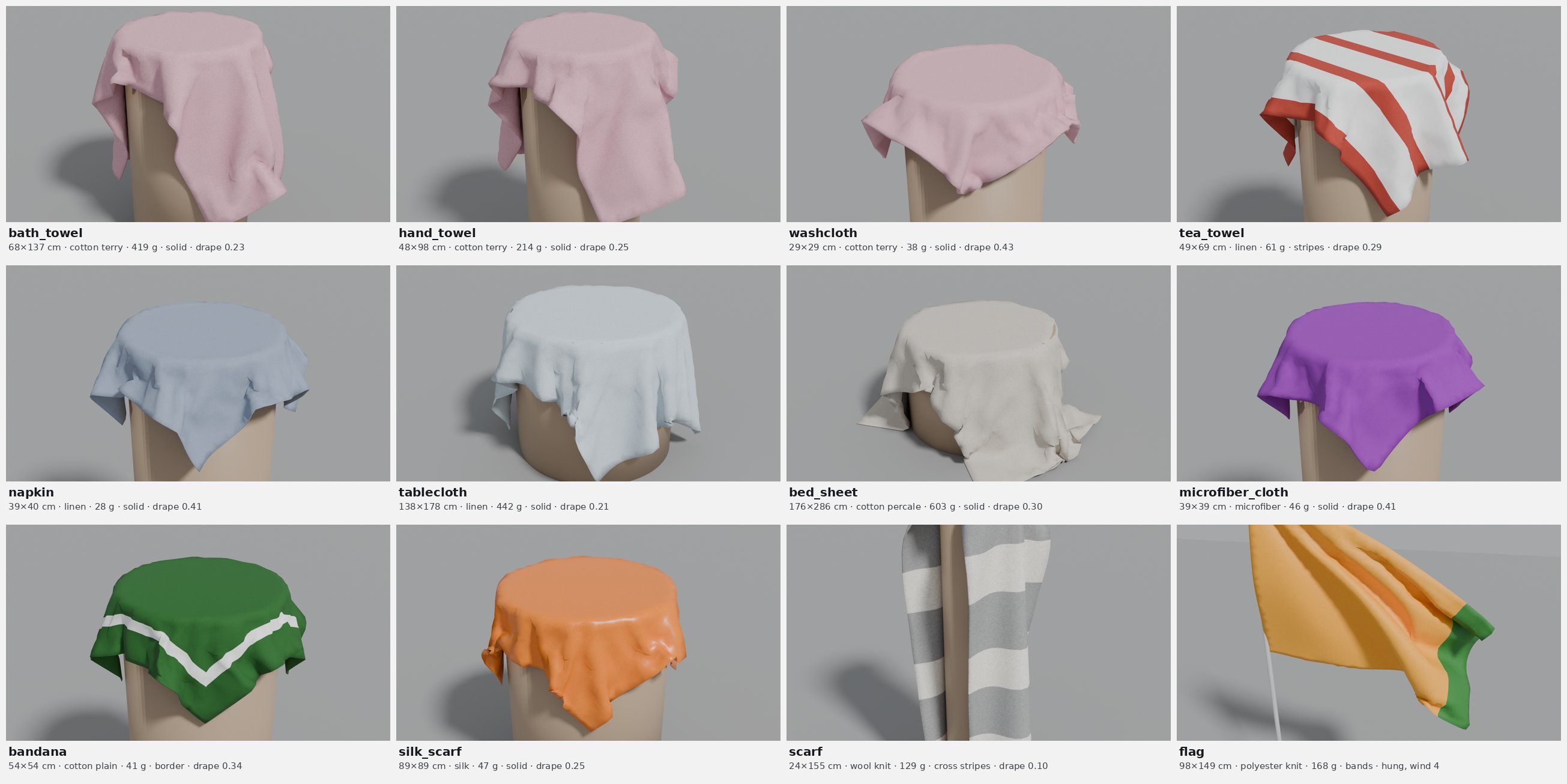
One piece of each preset (seed 2), simulated 5 s by the Blender drape test and rendered with Cycles; each image is framed on its own piece, so scales differ (30 cm washcloth to 3 m sheet). Same colours for the three terry presets: they share a palette and, with one seed, the same colour draw.
Sizes are common retail formats; values are realistic orders of magnitude, not measurements of a specific product. Flags use generic two or three band designs with random colours on unequal, asymmetric bands, so that real national flags (equal or symmetric bands) are unlikely.
Fabrics
| Fabric | Areal density | Thickness | Friction |
|---|---|---|---|
cotton_terry |
450 g/m² | 4 mm | 0.8 |
cotton_waffle |
220 g/m² | 1.5 mm | 0.6 |
cotton_plain |
140 g/m² | 0.3 mm | 0.5 |
cotton_percale |
120 g/m² | 0.25 mm | 0.5 |
linen |
180 g/m² | 0.35 mm | 0.55 |
denim |
400 g/m² | 0.7 mm | 0.6 |
fleece |
250 g/m² | 3 mm | 0.8 |
microfiber |
300 g/m² | 2 mm | 0.9 |
polyester_knit |
115 g/m² | 0.2 mm | 0.4 |
silk |
60 g/m² | 0.1 mm | 0.3 |
wool_knit |
350 g/m² | 3 mm | 0.7 |
--fabric gives every piece the same fabric, whatever the preset's mix.
Formats
Each preset draws from its own retail formats (table above). --format
(Python: formats=) replaces them with your sizes and shapes, in cm, as a
comma-separated list:
| Format | Shape |
|---|---|
50x70 (or rect:50x70, 50×70) |
rectangle, 50 × 70 cm |
oval:140x200 (or ellipse:140x200) |
ellipse, 140 × 200 cm |
round:150 |
circle, 150 cm in diameter |
50x70@3 |
any of the above with a weight (here 3; 1 when there is no @) |
Weights. Each piece draws one format at random, with a probability
proportional to its weight: weight / sum of the weights. With
--format "140x180@2,round:150,oval:140x220" the weights are 2, 1 and 1
(sum 4), so each tablecloth has a 50 % chance of being 140×180, 25 % of being
round and 25 % of being oval: about 6, 3 and 3 out of 12 on average, the exact
counts depending on the seed. Only the ratios matter (@2, @1, @1 is the
same as @50, @25, @25), and without any @ all formats are equally
likely. With --no-size, nothing is drawn: every piece takes the first format
of the list, at its exact size. The presets' own formats use the same weights
(a bath_towel is 70×140 with weight 0.7, 90×150 with weight 0.3).
The longer side is always the length, so 70x50 is the same as 50x70. The
preset's size tolerance, cut, corners, fabric and patterns still apply. In
Python, a format can also be a dict ({"width": 50, "length": 70, "shape":
"rect", "weight": 1}) or a tuple ((50, 70), (150, 150, "round")). With
--topology grid, round and oval formats are skipped (at least one rectangle
is needed). manifest.json counts the pieces of each format drawn, in its
summary.
Mesh
| Option | Default | Effect |
|---|---|---|
--topology tri |
✓ | near-equilateral triangles (Delaunay on a jittered hexagonal lattice, outline sampled at the same spacing); any outline; minimum angles above ~20° |
--topology grid |
structured quads stretched over the four cut edges (Coons patch); rectangles only, sharp corners; round formats are skipped | |
--vertices N |
1500 | target vertices per piece, whatever its size |
--count N, --seed S |
12, 1 | number of pieces, random seed; same options and seed give the same pieces |
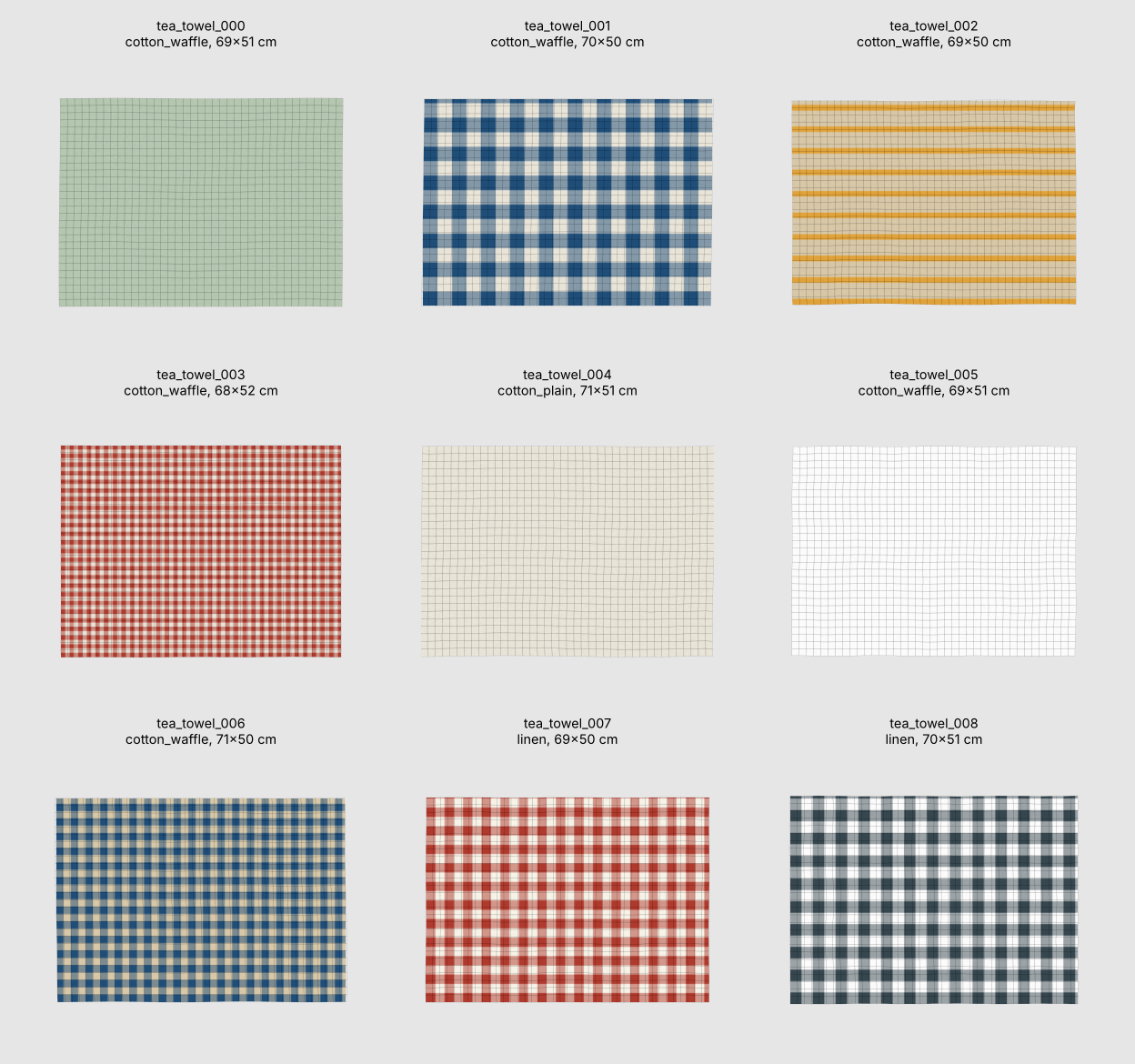
maillage preview output/tea_towel on a grid-topology set: the texture is
drawn over each piece and the mesh shown on top; the wavy grid lines are the
imperfect cut, spread across the piece.
Method in brief
- Outline. A rectangle with rounded corners or an ellipse, parametrised by arc length. The cut adds a smooth normal displacement (sum of a few sines along the perimeter: long gentle deviations plus a small wobble) and a slight shear.
- Mesh. tri: the outline is sampled at the target edge length (sharp corners kept, roundings below the resolution merged into one vertex), the inside filled with a jittered hexagonal lattice kept at least half an edge away from the outline, then a Delaunay triangulation clipped to the outline. grid: transfinite (Coons) interpolation of the four cut edges.
- Fabric and mass. The fabric is drawn from the preset's mix; the mass is the measured area times the areal density.
- Hem and pins. Vertices within the hem width of the outline get
hem = 1; for flags, vertices near the two hoist corners getpin = 1. - Pattern. Parameters drawn per piece (colours from the preset's palettes, periods, band widths), rendered on the nominal rectangle with a faint weave noise; texture coordinates follow the fabric, so a skewed or wavy cut shows as a pattern not quite parallel to the edge, as on real pieces.